

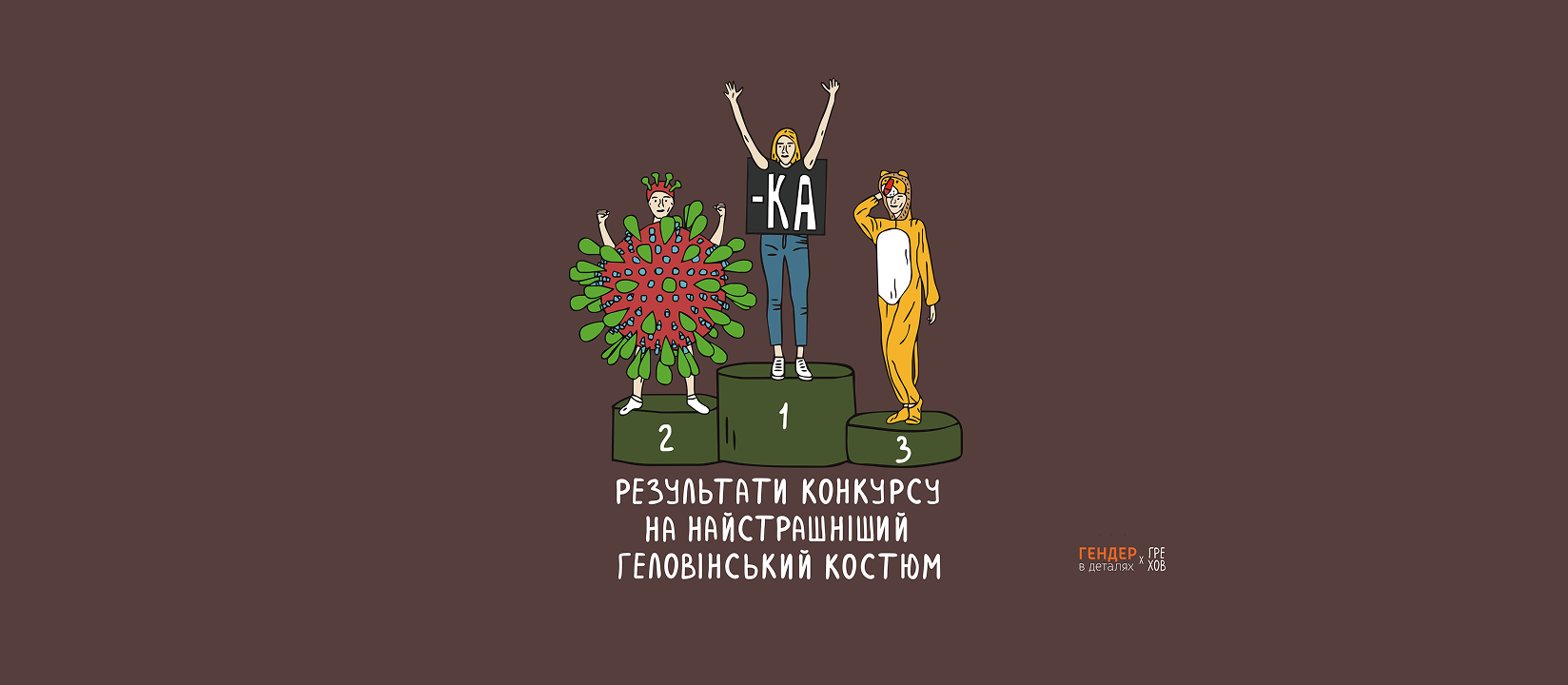

“‘A female journalist’ on a business card? You must be joking.”
Leonid Petrovych used to say I would lose my job before anyone printed the feminine form of “journalist” on my business cards. “Those kinds of business cards simply don’t exist,” he insisted.
One day, I was handed a stack of cards that identified me using the masculine form of the profession. I spent half the night adding the feminine ending by hand to every single one.
Leonid Petrovych was my editor ten years ago. An old Soviet-trained philologist, he addressed forty-year-old women journalists as “girls” and assigned them stories about cooking and health, even when they were accomplished professionals who understood economics and finance far better than he ever had. “Beauty is your greatest weapon,” he liked to say in his International Women’s Day toasts, before making his way around the room with unwanted hugs and oily compliments.
Whenever we argued about language, he would pull out an old dictionary, open it to the word “journalist,” and triumphantly point out that only the masculine form existed in print.
“Exactly!” I would reply. “I exist, but the word for me doesn’t?”
Ten years ago, fighting for feminine professional titles in Ukrainian was very different from what it is today. I argued with editors over the right to write “female director” rather than using the masculine form. Sometimes I even argued with women leaders themselves, because many considered feminine titles insulting or diminishing.
People who disagree with me about feminine professional titles often see this as a purely linguistic debate. For me, it never was. It is not stubbornness for its own sake, nor a passing trend. It is about visibility.
If I exist, there should be a word that names me.
In Ukrainian, nouns have grammatical gender. The word journalist is grammatically masculine. I do not call myself by the masculine form because my language contains a word that accurately reflects who I am.
Not so long ago, women were excluded from voting, higher education, and public life. There were no women journalists to name because women were largely absent from those professions. Yet there were feminine words for “cook,” “maid,” or “mistress.” Interestingly, defenders of linguistic tradition rarely object to those forms.
I find it difficult to accept a language in which I can be a “maid” or a “waitress,” but not a “director,” a “doctor,” or a “philosopher” in the feminine form. If people are comfortable with feminine titles for lower-status occupations, they should be equally comfortable with feminine titles for positions of expertise and authority.
A decade has passed since my battles with Leonid Petrovych. Today, I work in television news. Women are identified in our on-screen captions using feminine professional titles. In my country, there are not only ministers, but women ministers whose titles are written in the feminine form. Ukraine’s updated orthography officially recognizes these forms, making them a standard part of modern Ukrainian.
That is why I was surprised when, only a few weeks ago, a website I wrote book reviews for systematically removed feminine titles from my texts. “Author” in the feminine form became the masculine “author.” “Woman writer” became simply “writer” in the masculine form.
When I asked why, the editor—a young man—explained:
“Feminine professional titles don’t fit the style of our publication.”
Looking through the website, however, I noticed that the publication had no problem with words such as “actress,” “singer,” or “stripper.” What they objected to were feminine titles associated with expertise, authority, and intellectual work. After I challenged the decision, my article disappeared from the website altogether.
Perhaps that editor drinks lavender lattes, flies to Italy for holidays, and gets his hair cut in fashionable barbershops. Yet every time I think of him, I see Leonid Petrovych’s face.
Was I upset? Only a little.
Because feminine professional titles are now a legitimate and inseparable part of the Ukrainian language. They are increasingly common in the media, in public life, and among younger generations. For many Ukrainians, they are simply the most natural way to refer to women’s professions.
And, by the way, my business cards now say “journalist” in the feminine form.
Just like the business cards of all my friends working at respected media outlets.
No, Leonid Petrovych, I am not joking.


